
This site is registered on wpml.org as a development site. Switch to a production site key to remove this banner.
We all know QR codes by now, right? I mean, it is the main topic of this page. They’re those little black and white boxes you can find in various locations that, if scanned, can take you to a website or offer you a coupon.
But did you know that the QR code you see on a regular basis isn’t the only kind out there? In fact, there are several other examples of different kinds of QR codes, each with their own specifications and purposes.
In this piece I will go over just some of the different kinds of QR codes, what makes them different from each other, and what purposes they serve. So let’s get started!
What is a QR code?
A QR code, or quick response code, is a 2 dimensional image containing data that can be scanned like a bar code, either by a special device or a mobile phone. These codes are most often square and made up of smaller black and white squares, though this can vary as they are highly customizable.
QR codes can store a wealth of information and are used in a variety of areas. They can be used to distribute URL links, images, tracking information, event registration, contact information, various file types, and social media accounts.
Since QR codes exist in the real world as simple 2D images, they can be displayed basically anywhere you can put a picture and still be scannable. This could be on a business card, a poster, a flier, an advertisement, a sticker, or even on a digital screen, like in a TV show or video game.UPC barcodes

While not technically a type of QR code, UPC barcodes are intrinsically tied to the creation of QR codes and are considered the precursor. UPC codes, like QR codes, are flat images containing data on black and white lines.
However, whereas QR codes are 2 dimensional, able to store data up and down as well as left to right, UPC codes are one dimensional, only able to store data in one direction. This means that the amount of data that can be stored is fairly limited and cannot even support a full 26 letter alphabet.
The limitations of UPC barcodes are what led Japanese company Denso Wave to develop and create the QR code we know today.
Model 1 and 2

(Image source: qrcode.com)
Model 1 is the first QR code developed, improving upon the flaws of UPC barcodes by allowing for data to be stored vertically as well as horizontally. The appearance of this code was inspired by the classic board game Go, and is typically made of black and white squares, though the color and shape can vary.
Model 2 is a direct upgrade to model one, able to store over 6 times the amount of data and appearing to be made of more blocks. Model 1 and 2 are the typical codes one thinks of when they think of a QR code, and can be seen as the standard for all other codes.
Essentially, model 1 and model 2 are your basic QR codes. This is also the type of code you can make yourself with QR Code Developer.
Micro and rectangular micro


(Image source: qrcode.com)
As the name would imply, micro QR codes are smaller codes, both in terms of size and data storage capability. These codes are typically found on smaller times like electronic parts, wires, and pill bottles.
Rectangular micro QR codes, or rMQR codes, are a variation of this type of code that appear in a rectangular shape, rather than a perfectly square one. These are often used for narrower surfaces, like the smaller parts to a computer, and are able to store more data than the square micro QR codes.
Secret function
Secret function QR codes appear almost indistinguishable from your typical model 1 or 2 code, though they contain extra data that is secured and can only be scanned by a certain device or with certain clearance.
These allow companies and individuals alike to protect certain information and make sure that valuable assets don’t fall into the wrong hands. These are especially common in industries that require more secrecy and security, like in the fields of medicine and banking.
Frame

Frame QR codes look and function almost the same as model 1 and 2. However, these codes have an image or logo right in the center of the code. These are perfect for branding and businesses that want to be recognised just from the logo alone.
Functionally, they work the same as model 1 and 2 QR codes.
Other codes
The codes described above are only the tip of the iceberg, as there are several different kinds of QR codes, each with different specifications and purposes. Here are some more quick examples!
iQR
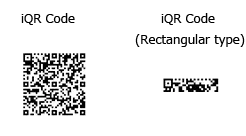
(Image source: qrcode.com)
Can be square or rectangular. These are newer, smaller, and can store more data, enough for entire catalogs and product specifications.
HCC2D
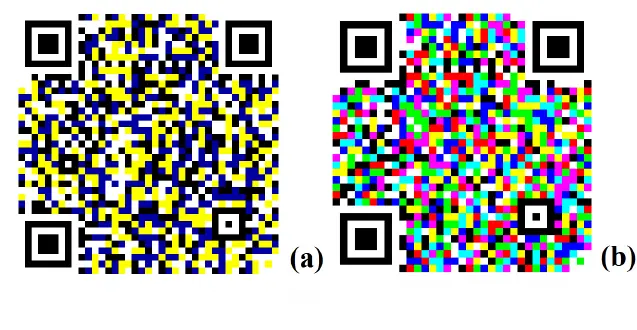
(Image source: researchgate.net)
New type of code still in development. Uses color to store more data.
Conclusion
As you can see now, there are many different kinds of QR codes. While model 1 and 2 are the ones you are more likely to see on an average day, there are others with specific use cases that you may have seen and wanted to know more about.
If you want to create your own model 2 QR code for personal or professional use, then you can with the free tool available from QR Code Developer. Get started now and see just how fun and easy it is to make your own QR codes!